

Guanacaste · Buyer’s Guide
Multi-Family Luxury Estates in Guanacaste: Benefits, Uses, and Due Diligence
A guide to dual-residence living, market context, ownership terms, and due diligence on Costa Rica’s Gold Coast.
Gina Briguglio · July 2026
One property. Two front doors. In Guanacaste’s coastal market, bedroom count alone does not determine how useful a property will be. Two independently functional residences can offer privacy, hosting flexibility, multi-generational accommodations, and several potential ownership or rental configurations that a single sprawling floor plan cannot.
These multi-family luxury estates contain two or more independently functional living environments instead of one continuous layout. They sit at the intersection of lifestyle and financial planning, which is why they appeal to buyers who want a single property to serve more than one purpose. What follows is a practical, evergreen look at why this property type appeals to certain buyers, how the market context stacks up, the legal and financial terms you need to know, and the due diligence that separates a smart purchase from an expensive assumption.
Why Multi-Family Luxury Estates Appeal to Buyers in Guanacaste
From Traditional Vacation Homes to Flexible Coastal Estates
A conventional Guanacaste vacation home typically serves one household. This arrangement works well for owners who primarily want a private second home. Some buyers, however, ask more of a property. They want a home that can earn income between visits, accommodate a growing family, and adapt as plans change. A single large villa may offer less flexibility on those fronts than a dual-residence estate.
The Appeal of Two Independent Residences on One Property
Two independent residences on a shared lot give you optionality that a bigger house may not. You can live in one and host in the other, keep aging parents close but not underfoot, or hand one residence to a property manager or caretaker while keeping the second entirely private. The value here is less about square footage than about separation, and the ability to reconfigure use without renovating.
Lifestyle Flexibility, Privacy, and Long-Term Use
Flexibility can pay off on both sides of the ledger. On the lifestyle side, it means privacy for family members and guests who keep different hours. On the financial side, it means a property whose use can shift with your circumstances — full-time residence, seasonal escape, guest compound, or future rental — without forcing a sale. Dual-residence estates have become a visible segment of Guanacaste’s coastal inventory, particularly for purchasers prioritizing privacy, guest accommodations, and flexible use.
What Is a Multi-Family Luxury Estate?
Clear definitions matter because real estate marketing often applies the term too broadly. For purposes of this guide, a multi-family luxury estate means a property containing two or more independently functional living environments — not one home with a spare bedroom, and not a main house with a converted closet. Each residence stands on its own. Terms such as “multi-family,” “dual-key,” “duplex,” “guest house,” and “two residences” can mean different things in permits, cadastral records, condominium documents, and marketing. Focus less on the label and more on how official records describe the property.
In the Guanacaste coastal market, that independence typically shows up as:
- Separate entrances for each residence
- Independent kitchens
- Private bedrooms and bathrooms
- Dedicated living and dining areas
- Separate or shared terraces
- Shared pools, gardens, or entertainment facilities
Multi-Family Estate vs. Conventional Single-Family Villa
A conventional villa is one household’s home. Guests typically share your kitchen, your living room, and often your wing of the house. A multi-family estate reduces that friction by giving the second party a complete residence of their own. The distinction is functional, not cosmetic — a detached studio or a bedroom with an en-suite does not by itself make a property “dual-residence.”
What Defines a Dual-Residence or Dual-Key Property?
A dual-residence or dual-key property in Costa Rica contains two complete living environments that can be occupied, closed off, or operated with a meaningful degree of independence. They may be connected under one roof, arranged as main-house-and-casita, or fully detached. A practical question is whether each side can function on its own, with its own entrance, kitchen, and private living space. For this guide, we consider any property that meets these functional criteria a dual-residence property. However, buyers should still verify its legal classification, permitted use, and supporting documentation in the official property records.
Common Layouts in Guanacaste’s Coastal Market
Common configurations include a side-by-side duplex, where two mirrored residences share a wall and pool deck; a main house with a smaller independent casita; and a stacked or terraced design, where hillside residences occupy separate levels to preserve ocean views and privacy.
Key Benefits of Dual-Residence Properties in Guanacaste
So why choose this configuration over a straightforward villa? The answer usually comes down to how many jobs you need one property to do.
Multi-Generational Living Without Sacrificing Privacy
Multi-generational living is one important reason for considering this configuration. Two complete residences let extended families stay close while keeping separate kitchens, bathrooms, and living areas. Grandparents keep their own rhythm. Adult children get their own front door. Everyone shares the pool and the sunset, and no one shares a coffee maker at 6 a.m. For multi-generational homes in Costa Rica, that balance of proximity and privacy is often the whole point.
Combining Personal Use With Guest Accommodations
You can occupy one residence and reserve the second for visitors — friends, relatives, or a rotating cast of houseguests — without opening your own living space to them. A home with a true, self-contained guest residence changes the social math of hosting. You get to be generous and private at the same time.
Flexible Short-Term and Long-Term Rental Options
Independent residences open rental options that a single villa cannot. Owners can keep one residence private while renting the other short term, combine both residences for larger peak-season groups, or lease one residence long term for steadier income. To be clear, none of this guarantees a return — it simply widens the menu of what the property can do.
Adapting the Property as Ownership Needs Change
Circumstances move. A property bought as a family retreat may later become a full-time residence, a caretaker compound, or an income-producing asset. A dual-residence layout can absorb those changes without a renovation, and shared amenities — one pool, one garden, one entertainment area — reduce duplication while preserving the separation that makes the whole thing work.
Market Factors Supporting Guanacaste Luxury Real Estate
A note on the numbers below. The market figures here come from named public sources, dated where possible, and are useful for orientation rather than a substitute for property-specific analysis. Before relying on any figure, confirm its reporting period, its exact geographic and property segment, and whether it reflects closed sales, asking prices, or tourism demand — asking prices are not what buyers actually paid, and national data is not the same as this coast.
Coastal Demand and International Interest
Guanacaste’s Gold Coast draws international buyers for reasons that predate any single statistic: direct air access through Liberia, a stable ownership framework for foreigners, and a dry-forest coastline that photographs like a postcard. National investment figures provide broader economic context, although they do not directly measure demand for residential property in Guanacaste. Costa Rica drew $5.12 billion in foreign direct investment in 2025 — its second consecutive year above the $5 billion mark, according to PROCOMER (reported April 2026), citing Central Bank (BCCR) figures. In that same reporting, tourism accounted for 7.5% of inflows and real estate 6.9% — 14.4% combined. Keep the scope in mind: this is national FDI, not a Guanacaste-specific figure. The report does not separate the coastal share, and these categories do not represent investment specifically in vacation homes or Guanacaste real estate.
Luxury Property Pricing Trends
Guanacaste remains one of Costa Rica’s highest-priced residential markets, particularly in established coastal communities, although asking prices vary substantially by location, property type, condition, views, and proximity to the beach. As a point of reference, according to Global Property Guide’s June 2025 listing-market analysis, the Guanacaste/Nicoya Peninsula recorded a median asking price of approximately $1.32 million — the highest in the country — down about 3.05% year over year. Read that carefully: it is a listing-market statistic from a secondary market-information provider (not Costa Rica’s official registry or a verified regional MLS closed-sales database), covering the broader Guanacaste/Nicoya Peninsula — not a median closed-sale price and not a Playa Potrero-specific figure. Always confirm the closed-sale data behind any appreciation figure.
Tourism Demand and Short-Term Rental Activity
Costa Rica’s tourism skews heavily international. The country received 2,661,488 visitors by air in 2024 — a 7.7% increase over 2023 — according to Costa Rican Tourism Institute (ICT) data. North America was the dominant source region, accounting for approximately 1.94 million air arrivals. The United States was the largest individual source country, accounting for approximately 59.6% of Costa Rica’s air arrivals in 2024. Notably for this region, Guanacaste Airport — officially Daniel Oduber Quirós International Airport (LIR) in Liberia — recorded 881,289 arrivals, up 14.5% year-on-year. Treat tourism as a supportive tailwind rather than a guarantee, and remember that national demand is not the same as occupancy for any one property.
Infrastructure Investment Along the Gold Coast
Improved roads, water systems, marine facilities, and commercial services can increase a community’s convenience and functional appeal. Evaluate infrastructure alongside location, supply, condition, views, legal status, and market demand when considering its effect on property values. Infrastructure may support appreciation, but it cannot guarantee it.
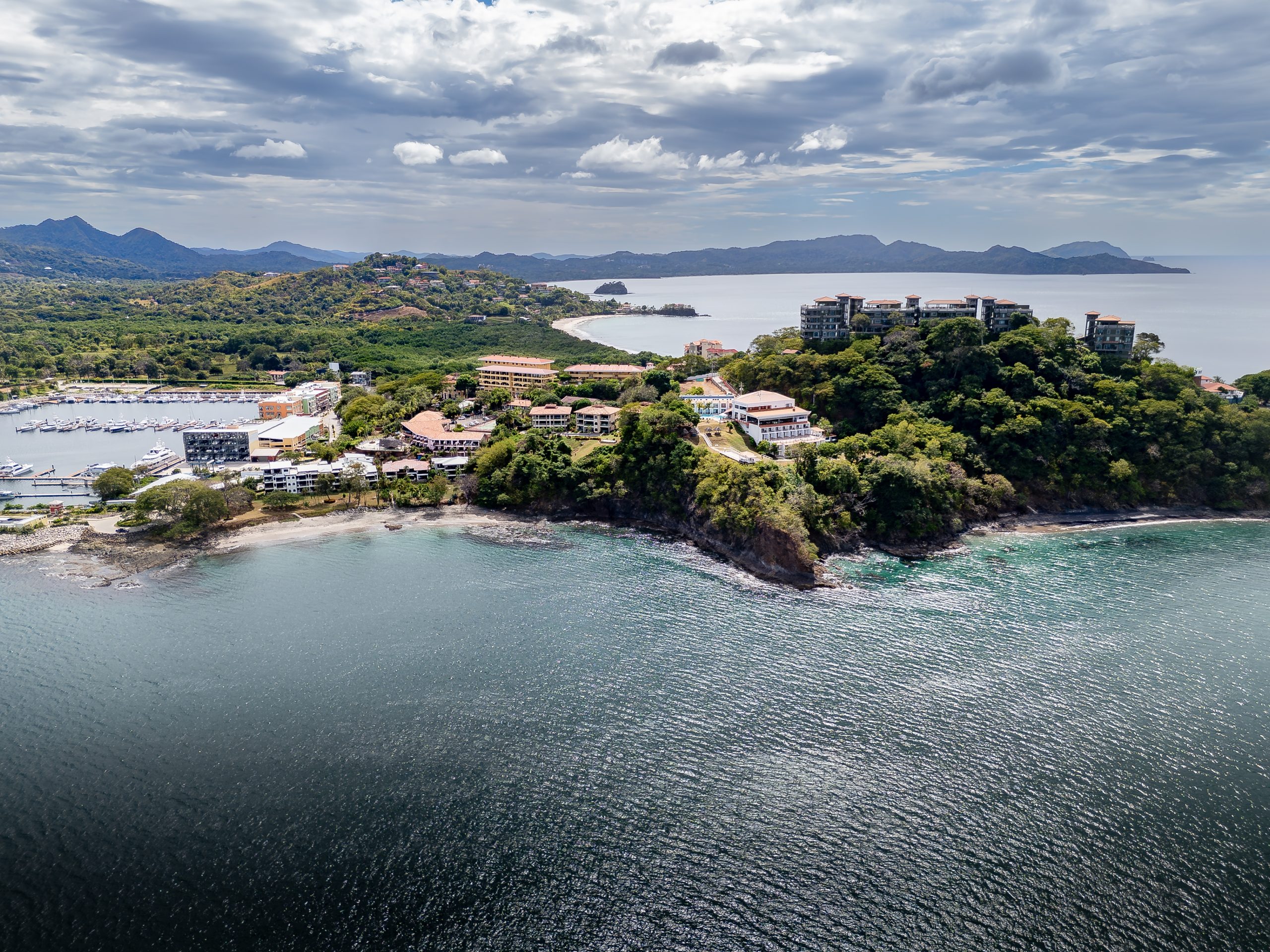
The Flamingo Marina Effect on Nearby Coastal Communities
Why Marina Access Influences Luxury Property Demand
Water access is no longer just about a beach view. For a segment of high-end buyers, proximity to Flamingo Marina — with its slips, fuel, and marine services — is a functional amenity in its own right. A marina turns a coastline into a launch point for boating, diving, and sportfishing. For purchasers interested in those activities, that convenience can add to a property’s practical and lifestyle appeal.
Playa Potrero, Playa Penca, and Playa Flamingo
The communities clustered around the marina — Playa Flamingo, Playa Potrero, and the quieter Playa Penca — each carry a slightly different character, from Flamingo’s established luxury market to Potrero’s mix of local life and upscale homes. What they share is easy access to the same marine hub.
Boating, Sportfishing, Dining, and Marine Services
The practical draw is the ecosystem around the water: waterfront dining, sportfishing charters, yachting and boat services, and the everyday convenience of keeping a vessel nearby. For buyers who intend to actually use the ocean rather than just look at it, that cluster of services can be a genuine differentiator.
How Infrastructure Can Support Long-Term Property Value
Proximity to marine infrastructure can strengthen a property’s long-term appeal. Keep the causation honest, though: a marina can support value, but it does not guarantee appreciation, and there is no transaction data here comparing properties before and after the marina’s development. Treat it as one input in a broader valuation, not the reason to buy.
Dual-Residence Property vs. One Large Luxury Villa
If you are weighing a duplex-style estate against a single six-bedroom villa, the differences are operational as much as architectural. The comparison below lays out the trade-offs.
| Factor | Dual-Residence Estate | One Large Villa |
|---|---|---|
| Privacy | Independent living areas | Primarily shared spaces |
| Rental configuration | May be offered separately or together | Generally offered as one property |
| Guest use | Greater separation | Guests share the primary residence |
| Multi-generational use | Strong | Depends on floor plan |
| Operating complexity | Potentially higher | Often simpler |
| Flexibility | High | Moderate |
Differences in Privacy and Daily Function
Day to day, the duplex keeps households apart; the villa keeps them together. Neither is inherently better — it depends on who is under the roof and how much separation they want.
Rental Flexibility During Peak and Shoulder Seasons
A properly configured dual-residence estate may support several operating arrangements. Owners may offer the residences separately to smaller groups or combine them as one larger estate. A single villa usually operates as one unit. Actual occupancy and rental performance depend on demand, pricing, location, property quality, management, and seasonality.
Operating Two Smaller Residences or One Combined Estate
Running two residences can mean more cleaning turns, more coordination, and more moving parts than a single home. That complexity is manageable with good management, but it is real and it costs money. Factor it in.
Which Configuration Fits Different Ownership Goals?
The honest bottom line: a duplex does not automatically earn more than a villa. Revenue depends on location, condition, pricing, management, seasonality, guest reviews, and operating strategy — not on the number of front doors. The right configuration is the one that matches how you actually intend to use and operate the property.
Evaluating the Income Potential of a Multi-Family Estate
If you are considering rental use, the single most valuable habit you can build is separating gross from net. Headline occupancy and nightly rates make for good marketing. Net yield is what actually lands in your account.
Gross Rental Income vs. Net Rental Yield
Start with the vocabulary. Gross booking revenue is total income before costs. Occupancy rate is the share of available nights booked. Average nightly rate is what each booked night earns. Subtract every operating cost — management, utilities, maintenance, insurance, taxes — and you arrive at net operating income. Divide that by the property’s value and you have net rental yield: the number that actually tells you whether the property performs.
Property Management and Operating Expenses
Costs stack up fast on a coastal rental. Property-management fees vary by company and service level: full-service vacation-rental management is commonly charged as a percentage of booking revenue, while long-term management is often priced differently and typically lower. Obtain written proposals from local managers before preparing a net-income projection. On top of management sit utilities, cleaning, landscaping and pool service, maintenance, insurance, platform fees, supplies, repairs, and a reserve for the things that inevitably break. Taxes belong here too, including the municipal property tax — generally 0.25% annually of the taxable value registered with the municipality — and, for qualifying homes, Costa Rica’s luxury home tax (impuesto solidario / Solidarity Tax), which applies above a threshold that is set annually and should be checked for the current year.
Seasonal Occupancy and Nightly Rate Considerations
You will see impressive occupancy figures quoted for the region, but read them for what they are. Short-term rental occupancy varies significantly by community, property type, price point, season, and data provider. Peak holiday occupancy should never be treated as a full-year average — the high season carries the year, while the green season is softer, and a credible projection blends both. None of it can be pasted onto any individual property.
Why Rental Projections Require Property-Specific Records
Rental performance varies significantly by property, season, pricing strategy, management, condition, amenities, and guest demand. Historical operating records should be reviewed before forming an income projection. If a seller cannot produce actual booking history and an itemized expense record, treat any income claim as a hypothesis. The numbers that matter are the property’s own — not the market’s averages.
Important Costa Rica Real Estate Terms to Understand
A confident buyer speaks the local language of ownership. These are the terms that come up in nearly every buying-property-in-Costa-Rica conversation.
Fee-Simple Titled Property
Fee-simple title (propiedad titulada) is direct, registered ownership — the strongest form of property right in Costa Rica, recorded in the National Registry. Foreign nationals can generally acquire and hold properly titled property directly or through a legal entity, subject to the same title review, registration, tax, and regulatory requirements applicable to the property. It is distinct from concession property, which is not owned outright but held under a government lease. Many inland and hillside properties on the Gold Coast are offered as titled property, while certain beachfront and near-shore parcels may fall under concession or other legal arrangements. The ownership status of each property must be verified individually.
Legal note
Costa Rica’s Maritime Terrestrial Zone runs 200 meters inland from the ordinary high-tide line. The first 50 meters generally constitute the public zone and form part of the public domain of the State. The following 150 meters generally form the restricted zone, where qualifying rights may be granted through municipal concessions rather than conventional fee-simple ownership. Most property within the 200-meter Maritime Terrestrial Zone is not conventional fee-simple property, although limited exceptions and previously registered titles may exist. Because the exact boundary and legal history are fact-specific, have a qualified Costa Rican real estate attorney confirm the status of any coastal parcel.
Maritime Zone and Concession Property
Costa Rica’s Maritime Terrestrial Zone (Zona Marítimo Terrestre), established under Law No. 6043, is the 200-meter strip measured inland from the ordinary high-tide line. Its first 50 meters form part of the public domain of the State and generally cannot be owned; the remaining 150 meters are administered through concessions, which carry their own restrictions on foreign ownership and use rather than fee-simple title. Concession rights are not freely available to foreigners on the same footing as titled property, and corporate participation in a concession can involve residency and ownership restrictions. Whether a given property touches this zone depends entirely on its exact location and legal history — which is why the map, not the marketing, decides.
ASADA Water Availability
In much of Guanacaste, water is delivered by community-managed associations known as ASADAs — though not every property is served by an ASADA; some rely on AyA, municipal systems, private systems, or legally approved wells. An ASADA water-availability letter (carta de disponibilidad de agua) documents whether the local water administrator has indicated service availability for a property or proposed project, subject to the letter’s conditions, validity period, capacity, and applicable permitting requirements. It does not by itself guarantee unlimited supply, future expansion approval, building permits, or permanent service under every condition. On this coast, water is not a given — confirming availability can be as important as confirming title, especially if you plan to expand.
Municipal Property Tax and Luxury Home Tax
Two taxes matter most. The municipal real-property tax is generally 0.25% annually of the taxable value registered with the municipality (the municipal declared value, which may differ from the National Registry purchase value). Separately, Costa Rica’s Solidarity Tax (impuesto solidario, the “luxury home tax”) applies to qualifying residential-use properties when the taxable construction value exceeds the threshold established for that tax year, on a graduated scale (for 2026, Hacienda published rates from 0.25% to 0.55%). The calculation is not based solely on the property’s listing or purchase price. Both should be verified for the current year and the specific property.
Costa Rican Corporations and Property Ownership
Property can be held personally or through a Costa Rican legal entity, most often a Sociedad de Responsabilidad Limitada (S.R.L.) or Sociedad Anónima (S.A.). Each structure carries its own tax, liability, and administrative implications. There is no universally “correct” choice — the right one depends on your circumstances and should be decided with qualified legal and tax advice.
Due Diligence for Multi-Family Properties in Guanacaste
Multi-family estates add wrinkles that a single villa does not have — chiefly, every residence and outbuilding must be legally sound on its own. Work through this checklist before you commit.
Confirming Title, Surveys, and Property Boundaries
- Run a full title search in the National Registry to confirm ownership, liens, and encumbrances
- Review the plano catastrado (registered survey) and confirm the boundaries on the ground match the map
- Verify access rights and any easements affecting the parcel
Reviewing Water Availability and Infrastructure
- Obtain the ASADA (or applicable provider’s) water-availability letter and confirm current service
- Assess septic capacity and utility connections for both residences
- Check electrical supply and internet service adequate for full occupancy
Verifying Building Permits and Existing Structures
- Confirm construction permits exist for every structure, including the caretaker residence
- Verify that each residence is legally recognized — not an unpermitted addition
- Commission an independent structural inspection
- Review HOA or condominium documentation where applicable
Evaluating Expansion Potential
- Check municipal land-use rules and setbacks before assuming you can add a casita
- Confirm water and permit availability for any planned expansion
Reviewing Rental History and Operating Costs
- Request actual booking records and itemized operating expenses if income use is being evaluated
- Reconcile any income claims against bank deposits and platform statements
Common Misconceptions About Costa Rica Property Ownership
Can Foreigners Own Property in Costa Rica?
Myth: foreigners cannot own property. In practice, foreign nationals can generally own fee-simple titled property in Costa Rica either personally or through a Costa Rican entity, subject to the same title, registration, tax, and regulatory requirements that apply to the property. Concession property in the maritime zone follows different rules, which is where confusion usually creeps in.
Is a Costa Rican Partner Required?
Myth: you need a local partner. For titled property, a Costa Rican ownership partner is not generally required. You can hold title in your own name or through a company you control. As always, the specifics of your situation warrant professional advice.
Does a Larger Villa Always Produce More Rental Income?
Myth: bigger always earns more. Not necessarily. Configuration and demand often matter as much as total bedroom count. A well-run dual-residence estate that can list separately or together may sustain higher occupancy than a large villa that only appeals to big groups. The word is “may” — the outcome still depends on the specifics.
Are All Coastal Properties Located in the Maritime Zone?
Myth: everything near the beach is concession land. Properties near the coast may be titled or concession-based depending on their exact location and legal history. Only a proper title and survey review can tell you which one you are looking at. Nothing here is individualized legal advice — confirm your specific property with a qualified Costa Rican attorney.
A Real-World Example: An Ocean-View Duplex in Playa Potrero
Featured Property
Terrazas del Sol — Playa Potrero
To ground all of this in something concrete, consider Terrazas del Sol, an ocean-view duplex in Playa Potrero, offered at $1,299,000 — a useful illustration of the multi-family configuration described throughout this guide, not evidence that every dual-residence estate delivers a particular return. The property contains two self-contained three-bedroom residences, each with a kitchen, living areas, and a separate entrance. Their permitted use and any rental requirements should be confirmed during due diligence. A dedicated caretaker residence and space for a potential future casita — subject to municipal approvals, permits, setbacks, zoning, and confirmed water availability — further support the property’s flexibility. Located near Playa Flamingo, Flamingo Marina, and Las Catalinas, it illustrates how a dual-residence configuration may accommodate seasonal living, extended-family use, guest accommodations, or potential rental operations, subject to legal review and property-specific financial records.
| Feature | Detail |
|---|---|
| Location | Playa Potrero, Guanacaste; near Playa Flamingo, Flamingo Marina, and Las Catalinas |
| Price | $1,299,000 |
| Configuration | Two independently functional three-bedroom residences |
| Bedrooms / bathrooms | 6 bedrooms total; 4 full and 2 half bathrooms |
| Interior / lot | 2,314 sq. ft. combined interior; 1,689 m² hillside lot |
| Shared amenities | Resort-style pool, covered outdoor kitchen, ocean-view terraces |
| Additional | Caretaker residence; space for a potential future casita (subject to approvals) |
Who Should Consider a Multi-Family Luxury Estate?
This property type is not for everyone, and that is fine. It tends to suit specific situations rather than the general buyer. It may be a strong fit for:
- Extended and multi-generational households that want proximity with privacy
- Seasonal residents who leave the property for months at a time
- Frequent hosts who want to separate guest space from private space
- Shared-ownership arrangements between families or partners
- Owners who need staff or caretaker accommodation on site
- Those considering future rental use of a second residence
- Households wanting dedicated space for work, wellness, or guests
Across all of these situations, the common thread is adaptability — the ability to keep a property useful as plans shift over a decade. For buyers weighing a luxury investment property in Guanacaste, that adaptability is often the deciding factor.
How to Compare Multi-Family Luxury Properties
When you have more than one candidate in front of you, a consistent checklist keeps the comparison honest. Evaluate each property against the same points:
- Whether each residence is genuinely independent — entrance, kitchen, and private space
- Bedroom and bathroom distribution across the two residences
- Kitchen quality in both residences, not just the primary one
- Private entrances and dedicated parking
- Sound separation and privacy between the residences
- Ocean views from both living environments, not only one
- The balance of shared versus private outdoor areas
- Road access and conditions to the property
- Water, septic, and electrical capacity for full occupancy
- Caretaker or management accommodation on site
- Realistic expansion possibilities, subject to approvals
- Distance to beaches, groceries, restaurants, and marine facilities
Final Considerations Before Purchasing in Guanacaste
Balance Lifestyle Goals With Property Mechanics
The best purchases balance the dream with the operating reality. Flexible layouts support different uses over time, but two residences also mean more to run than one. Know which trade-off you are making.
Verify Market Claims With Current Local Data
Location and infrastructure remain essential, and the market context in this guide is a starting point — not a substitute for current, local, property-specific data. Any rental potential must be evaluated using the property’s actual records. If you want to understand living in Guanacaste, Costa Rica before you commit, spend time on the coast in both high and green season.
Complete Legal, Structural, and Financial Due Diligence
Legal, structural, and financial due diligence matters as much as the views and the amenities. A dual-residence estate can offer advantages a standard villa cannot — alongside operations that are genuinely more complex. Go in with both eyes open, and the configuration can serve you for decades.
Explore Multi-Family Estates on the Gold Coast
Explore current multi-family homes, ocean-view duplexes in Playa Potrero, and flexible luxury estates throughout Guanacaste — or arrange a private showing of Terrazas del Sol.
+506 8423 4370 | +1 312 399 2857
info@costaricarealestatecr.com
Frequently Asked Questions
What is a multi-family luxury estate in Guanacaste?
For purposes of this guide, a multi-family luxury estate generally means a property containing two or more independently functional living spaces on one property. Each residence may include private bedrooms, bathrooms, a kitchen, and living areas with a separate entrance, while sharing amenities such as a pool, garden, or outdoor entertainment area.
What is a dual-residence property?
A dual-residence property contains two complete living environments within one estate. The residences may be connected, detached, or arranged as a main home and guest house, but each can function with a meaningful degree of independence.
Can foreigners own property in Guanacaste, Costa Rica?
Foreign nationals can generally own fee-simple titled property in Costa Rica in their own name or through a Costa Rican legal entity, subject to the same title, registration, tax, and regulatory requirements that apply to the property. Coastal concession property is governed by different rules, so the title and location should be reviewed by a qualified Costa Rican attorney.
Is a duplex a good investment in Costa Rica?
A duplex can offer flexible residential and rental uses because the residences may be occupied or operated separately or together. Its actual investment performance depends on location, purchase price, condition, operating expenses, management, seasonal demand, and rental strategy.
Can one side of a duplex be used while the other is rented?
A properly designed duplex may allow one residence to remain in private use while the other is rented. Local regulations, property rules, insurance, management requirements, and the physical independence of each residence should be evaluated first.
Are multi-family properties suitable for multi-generational living?
Yes. Two complete residences can provide proximity while preserving separate kitchens, bathrooms, bedrooms, and living areas. This can be particularly useful for extended families, adult children, visiting relatives, or household staff.
Do dual-residence properties earn more than single-family villas?
Not necessarily. Dual-residence properties can offer more booking configurations, but revenue depends on demand, pricing, property quality, location, reviews, seasonality, and management. A property-specific financial analysis is necessary.
What expenses affect net rental yield in Guanacaste?
Expenses may include property management, utilities, cleaning, maintenance, landscaping, pool service, insurance, municipal property tax, applicable Solidarity (luxury home) tax, platform fees, supplies, repairs, and reserve funds.
What is an ASADA water-availability letter?
An ASADA water-availability letter documents whether a local community water administrator has indicated service availability for a property or proposed project, subject to the letter’s conditions, validity period, and capacity. Note that some properties are served instead by AyA, municipal systems, private systems, or legally approved wells.
What due diligence is required before buying a multi-family property?
Due diligence commonly includes reviewing title, surveys, access, permits, water availability, utilities, septic systems, construction records, taxes, structural condition, rental documentation, and the legal status of every building on the property.
Is Playa Potrero a convenient location for a multi-family estate?
Playa Potrero provides access to beaches, restaurants, grocery stores, coastal services, Playa Penca, Playa Flamingo, Flamingo Marina, and Las Catalinas. Individual properties should still be evaluated for exact road access, elevation, travel times, and infrastructure.
Sources & methodology
Foreign direct investment, 2025: PROCOMER — Costa Rica Exceeds $5 Billion in FDI for the Second Consecutive Year, citing the Central Bank of Costa Rica (BCCR). Costa Rica recorded approximately $5.12 billion in FDI in 2025; tourism accounted for 7.5% and real estate 6.9% of total inflows.
Tourism arrivals, 2024: CentralAmerica.com — Costa Rica Tourist Numbers 2024, reporting Costa Rican Tourism Institute figures: 2,661,488 air arrivals (+7.7% year over year); North America ~1.94 million; Guanacaste Airport (Daniel Oduber Quirós International, LIR) 881,289 (+14.5%). Official reports: ICT Statistical Reports.
Median asking price, June 2025: Global Property Guide — Costa Rica Residential Property Market Analysis. Guanacaste/Nicoya Peninsula median asking price ~$1.32 million, down ~3.05% year over year — secondary listing-market information, not an official closed-sale statistic.
Maritime Terrestrial Zone (Law No. 6043): Costa Rican Tourism Institute — Maritime Terrestrial Zone, Law No. 6043.
Solidarity Tax, 2026: Ministerio de Hacienda — 2026 Solidarity Tax Notice; additional context from AG Legal and The Tico Times.
Market figures are provided for general orientation only. Confirm the reporting period, geographic coverage, methodology, and property segment before relying on them. Property-specific matters — title, concessions, permits, water availability, construction records, taxes, and rental performance — should be reviewed with qualified Costa Rican legal, tax, engineering, and real estate professionals.

Gina Briguglio is the founder of Costa Rica Real Estate CR and a Realtor with more than 30 years of experience, focused on Guanacaste’s Gold Coast. She is a Certified International Property Specialist (CIPS) and a member of CRGAR and NAR. Reach her at +506 8423 4370 · +1 312 399 2857 · info@costaricarealestatecr.com, or view her profile.